

Intro to Mentally Healthy Workplaces & Psychosocial Risk Management
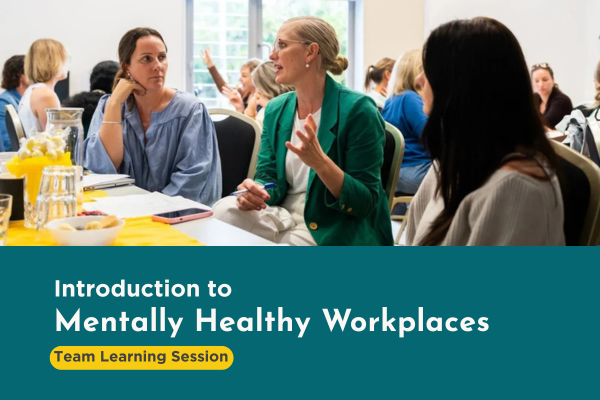
Give your team a short, practical introduction to mentally healthy workplaces.
Psychological health and safety is a core workplace obligation under Australian Work Health and Safety (WHS) laws.
Organisations are required to actively manage risks to both physical and psychological health. This includes identifying and controlling hazards arising from the way work is designed, managed and experienced by employees.
Introduction to Mentally Healthy Workplaces is a short, sharp 1-hour session designed to build organisation-wide awareness of psychosocial risks and WHS responsibilities – ideal for staff meetings, leadership forums, mental health theme days and lunch and learn sessions.
What is psychosocial risk management?
Psychosocial risk management is the systematic process of identifying, assessing and controlling workplace factors that may cause psychological harm.
Under WHS laws, psychosocial hazards must be managed using the same risk management framework applied to physical hazards.
Psychosocial risk management focuses on fixing how work is designed and managed – not just supporting individuals after harm has occurred.
Why employers need to prioritise psychosocial risk management
Work-related psychological injuries are one of the fastest-growing categories of workers’ compensation claims in Australia. They are often more complex, longer in duration and more costly than physical injury claims.
Beyond cost, poor management of psychosocial risks can lead to:
increased absenteeism and turnover
reduced productivity and engagement
workplace conflict and complaints
reputational and regulatory risk
A mentally healthy workplace is built through prevention – not just wellbeing programs.
Employer obligations under WHS laws
Under the Work Health and Safety Act 2011 and corresponding State and Territory legislation, employers have a positive duty to ensure, so far as is reasonably practicable, the health and safety of workers.
This duty explicitly includes psychological health.
In addition, the Model Work Health and Safety Regulations now include provisions requiring organisations to manage psychosocial hazards, reinforcing that these risks must be treated the same as physical safety risks.
In practical terms, employers must:
identify psychosocial hazards in the workplace
assess the level of risk to workers
implement controls to eliminate or minimise risks
monitor and review the effectiveness of those controls
Failure to meet these obligations may result in regulatory enforcement, penalties and increased liability.
What is a psychosocial hazard?
A psychosocial hazard is any aspect of work design, management or workplace interactions that has the potential to cause psychological harm.
Common examples include:
excessive workloads or unrealistic deadlines
poor change management practices
workplace bullying, harassment or unresolved conflict
unclear roles or competing priorities
lack of support from managers
exposure to traumatic or high-pressure situations
Psychosocial hazards are usually systemic – they arise from how work is structured, not from individual employees.
Why offer a 1-hour introductory session to all staff?
Many organisations understand their obligations but struggle to build consistent awareness across teams.
A short, targeted session is often the most effective starting point.
Introduction to Mentally Healthy Workplaces is a 1-hour introductory session designed to:
provide a clear overview of psychosocial risk and WHS obligations
build shared language across teams
help leaders and employees recognise common hazards
support early identification and prevention of risks
Introduction to Mentally Healthy Workplaces is concise and accessible, so the session can be delivered as part of:
team meetings
leadership briefings
all-staff forums
lunch and learn sessions
wellbeing theme days
Awareness is a critical control measure – if leaders and teams can’t recognise psychosocial risks, they can’t manage them.
What participants will learn:
This introductory session provides a practical, high-level overview of:
what makes a mentally healthy workplace
what psychosocial safety means
employer obligations under WHS legislation
common psychosocial hazards and how they arise
the basics of risk identification and assessment
simple, practical concepts to discuss, action and support psychologically safe work environments
The session is designed to be engaging, easy to understand and immediately applicable in day-to-day work.
Who this session is for
The session is suitable for all staff, including:
organisational leaders and executives
managers and supervisors
HR and People & Culture teams
WHS and safety representatives
frontline employees and all teams
It is particularly valuable for organisations looking to introduce psychosocial risk concepts before implementing more detailed training or risk management systems.
A practical first step toward compliance
For many organisations, psychosocial risk management can feel complex or overwhelming.
A short, well-structured introduction provides a practical and accessible starting point – helping teams to understand their responsibilities and begin building a mentally healthy workplace.
It can also complement more in-depth training, such as half-day programs focused on implementation and leadership capability.
Build awareness. Strengthen compliance. Support your people.
Creating a mentally healthy workplace starts with understanding.
Our Introduction to Mentally Healthy Workplaces session helps organisations take a proactive first step – building awareness, supporting compliance and equipping teams to recognise and respond to psychosocial risks.
To book a session for your team or include it in your next leadership discussion staff meeting, wellbeing day or lunch and learn program, please contact us today.
